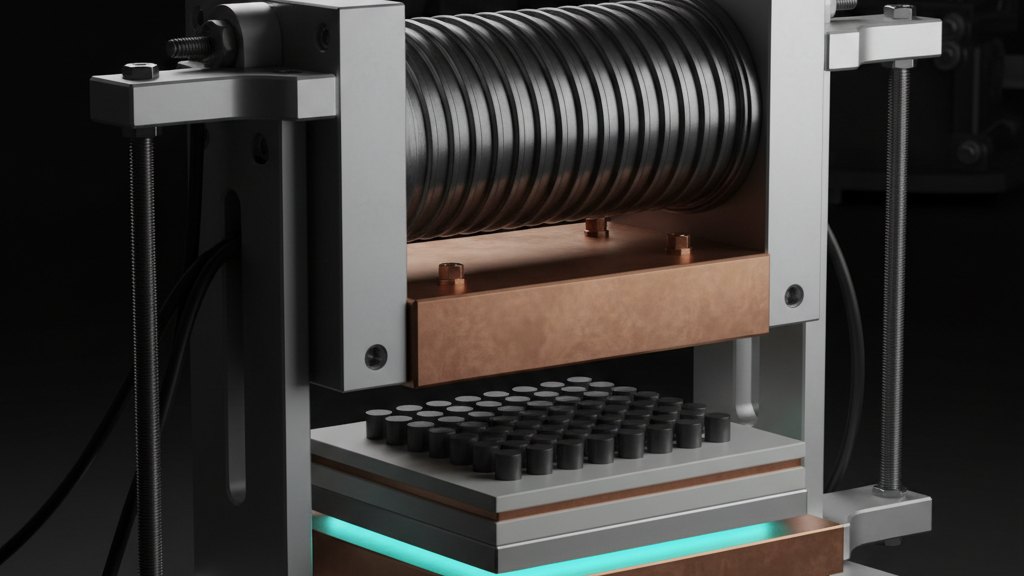

The European Union Battery Regulation 2023/1542 is the most comprehensive battery lifecycle legislation yet enacted, and 2026 is the year its requirements become operational for industrial batteries. On 18 February 2026 industrial rechargeable batteries exceeding 2 kWh capacity became subject to verified carbon footprint declarations, extending an obligation that took effect for electric vehicle batteries in February 2025.
Carbon footprint declarations and the data behind them
The requirement is not a headline number but a structured disclosure. Industrial battery producers must calculate and declare greenhouse gas emissions across the entire production process, from raw material extraction through cell assembly, with granular data collection at component level covering cathode precursor production, electrolyte synthesis, separator manufacturing and final cell integration. Emissions must be disaggregated by lifecycle stage, exposing upstream supply chain emissions that often represent 60–70% of a battery's total footprint. Third-party verification can require 6–12 months of data collection and documentation, which is why the deadline has practical consequences well before it arrives.
Labelling obligations run alongside. For industrial, starting-lighting-ignition and electric vehicle batteries containing cobalt, lead, lithium or nickel in active materials, manufacturers must state the percentage share of recycled content by material. Minimum recycled content thresholds begin on 18 August 2031 at 16% for cobalt, 85% for lead, 6% for lithium and 6% for nickel.
Recovery targets, EPR and the passport
Recycling efficiency requirements become mandatory for authorised treatment facilities from 31 December 2027, with minimum recovery of 80% by mass for nickel-cadmium, 75% for lead-acid and 65% for lithium-based batteries, rising for lead-acid to 80% and lithium-based to 70% in 2030. Material-specific targets are more demanding: 90% recovery for cobalt, copper, lead and nickel by end-2027, rising to 95% by 2031, with lithium recovery escalating from 50% by end-2027 to 80% by end-2031. A harmonised calculation methodology adopted in July 2025 standardises mass balance accounting across member states.
Extended producer responsibility obligations are fully enforceable through 2026, requiring free collection systems and collection rates of 63% for portable batteries by end-2027 and 73% by 2030. The digital battery passport becomes mandatory on 18 February 2027 for industrial, electric vehicle and light means of transport batteries above 2 kWh, accessed through a QR code and updated across operational life with state-of-health and maintenance data. As guidance on the EU Battery Regulation's 2026 compliance deadlines stresses, the platform, supplier integration and battery management connectivity all have to be built during 2026. Recycled materials help on both fronts: lifecycle analysis data cited in the same guidance puts their carbon footprints 58–81% below virgin mined equivalents.
The exergy view
A recovery target expressed in per cent by mass is a first-law instrument applied to a second-law problem. Recovering 65% of a lithium battery's mass says nothing about whether the recovered fraction retains the quality that made it valuable, and mass-based accounting rewards heavy, low-grade streams over the scarce, deeply refined elements. The material-specific targets for cobalt, nickel, copper and lithium partly correct this by tracking the elements whose separation consumed the most work. The regulation's carbon footprint and recycled content provisions point the same way: recycled cathode metals carry a far lower cumulative exergy demand than virgin equivalents because the concentration step has already been paid for. A passport that recorded recovered material quality, not merely quantity, would close the loop properly.