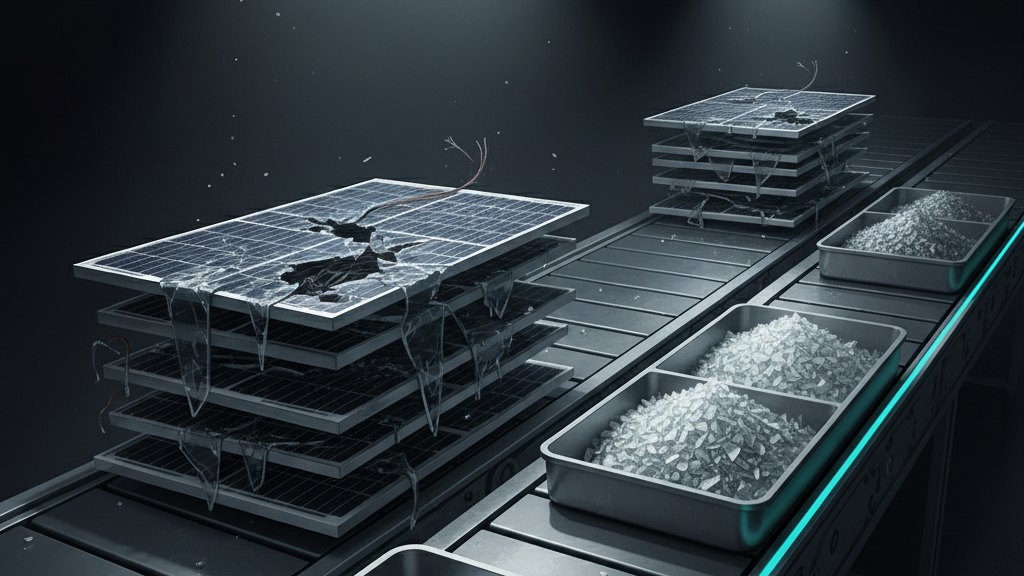
Photovoltaic module recycling is making meaningful advancement across both commercial and pilot-scale technologies, according to a new report from the IEA Photovoltaic Power Systems Programme published in May 2026. The Task 12 report presents new and updated life cycle inventory data and finds measurable improvements over prior studies in material recovery rates, process yields and output purity.
Recovery rates and the materials that matter
Data sources include two United States commercial crystalline silicon recyclers, Solarcycle and SPR, the Italian pilot-scale recycler 9-Tech, the EU-funded Photorama project, and updated global inventory data on cadmium telluride modules from First Solar. The change since a 2024 study is stark: the pure-mechanical benchmark technology then recovered neither silicon nor silver.
- Silicon: SPR reports recovery of 98 wt% of input silicon using a pure-mechanical process at commercial scale; 9-Tech achieves 95 wt% in a pilot system combining mechanical, thermal and chemical processing.
- Silver: Solarcycle reports nearly 92 wt%; 9-Tech 90 wt%.
- Copper: SPR reports 99%, Solarcycle approximately 95 wt%, 9-Tech 95 wt%.
- Aluminium: 9-Tech reports 90 wt%.
- Thin film: First Solar reports more than 90 wt% recovery of semiconductor material and more than 90 wt% of metals beyond it.
The report describes non-ferrous metal recovery — silver, aluminium and copper — as a new capability for mechanical processes at scale. Purity has also advanced: Photorama achieves 5N purity for silicon and greater than 2N for silver, SPR reports 99% purity for recovered copper and other trace metals through mechanical processing, and 9-Tech reaches up to 95% purity for copper and silver in recovered metallic powders.
Glass, reuse pathways and what is still missing
Glass recovery has progressed on 2024 levels, with mechanical, thermal and other separation approaches such as flash lamp separation and water jet cleaning achieving high glass yield and purity, though these may require more energy than pure mechanical processes. Reuse applications are widening: recovered silicon is going into battery anodes, sputter targets and metallurgical-grade applications, non-ferrous metals to metal recyclers, smelters and refineries, and recovered glass into flat glass production.
The report is equally clear about limits. As pv magazine USA reported on the Task 12 findings, persistent gaps remain in material quality reporting, system boundary harmonisation and energy-use characterisation, and better information on downstream use and treatment pathways is needed to quantify material recovery, energy recovery and landfill disposal. A forthcoming Task 12 study will develop life cycle assessment-based analyses of different recycling pathways.
The exergy view
Recovery rate and purity are not interchangeable measures, and the report's insistence on reporting both is thermodynamically correct. Recovering 98% of a module's silicon by mass is only valuable if the recovered material retains enough quality to substitute for something; that is why the destination matters — battery anodes and metallurgical-grade uses demand far less purity, and therefore far less further work, than a return to solar-grade ingots. Purity figures such as 5N silicon and greater than 2N silver are statements about how much of the original separation exergy has been preserved. The caution on glass is the same principle inverted: high yield achieved with more energy input can move the balance the wrong way. Without harmonised boundaries and energy-use data, no honest exergy accounting of a recycling route is possible.