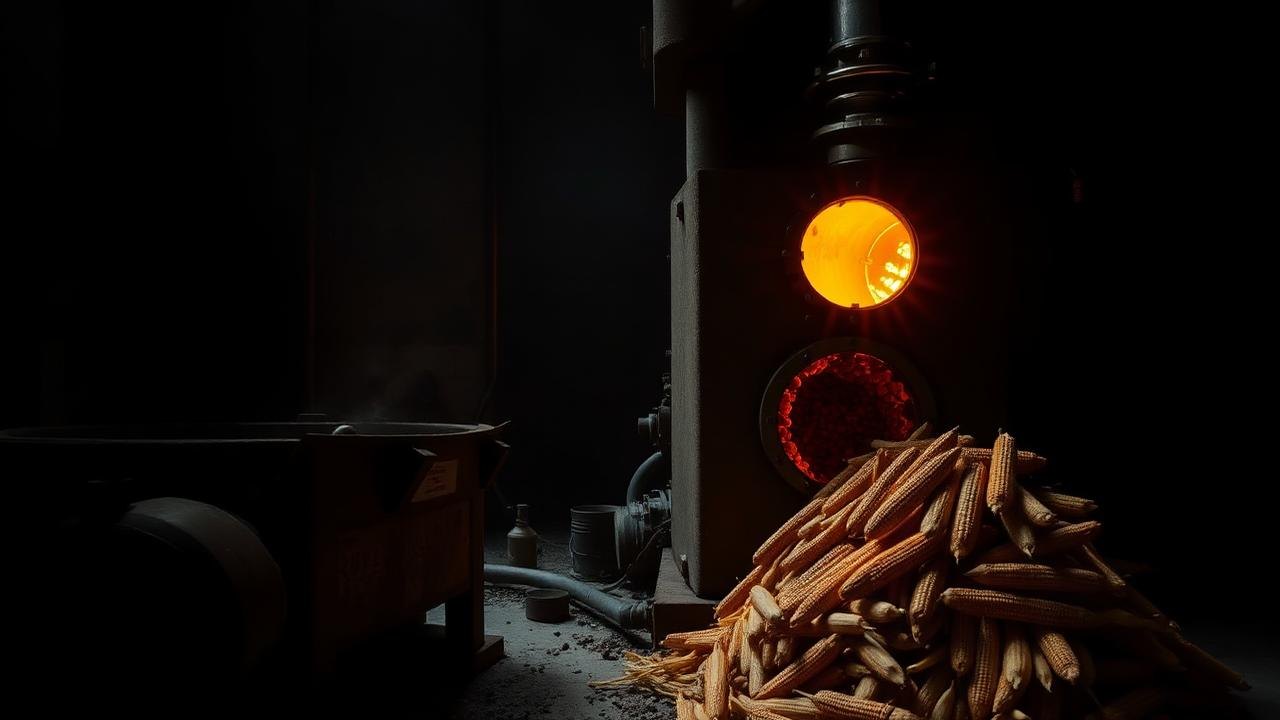
Most small gasifiers are autothermal: part of the feedstock is burned inside the bed to supply the heat the endothermic reactions need. It is simple and it is thermodynamically expensive, because the combustion happens at high temperature and its product gas dilutes everything downstream. The allothermal alternative heats the bed from outside. This open access study in Energies applies exergy accounting to that architecture, using maize cobs in a concentric tube fixed-bed reactor.
What the architecture changes
Separating the heat source from the reaction zone has three consequences. The producer gas is not diluted with nitrogen and combustion products, so its chemical exergy per cubic metre is higher. The bed temperature can be controlled independently of the equivalence ratio, which decouples two variables that are locked together in an autothermal design. And the heat now has to cross a wall, which introduces a temperature difference and therefore an irreversibility that the autothermal route does not have.
The exergy balance is the only framework that prices all three at once. Energy accounting rewards the allothermal design for its richer gas while ignoring the quality of the external heat used to make it; exergy accounting charges for that heat at its true work potential, which is the honest comparison.
Feedstock and benchmark
Maize cobs are a genuinely residual feedstock, produced at the point of processing rather than gathered from the field, with low moisture and consistent particle size. The study benchmarks its results against efficiencies of around 66% reported for pine wood chip waste, which places the maize cob route within the band already established for woody residues rather than in a class of its own. That is a useful, unglamorous finding: the feedstock is competitive, and the case for using it rests on availability and logistics rather than on any thermodynamic advantage.
The exergy view
The temptation with allothermal designs is to declare victory on gas quality. The exergy balance refuses that shortcut, because it asks where the external heat came from. Heat delivered at 800 °C or above carries most of the work potential of the fuel that raised it, and if that fuel is the same biomass being gasified, the system has simply moved the destruction from inside the bed to outside it. The architecture only wins where the external heat is genuinely surplus — recovered from a process that would otherwise reject it, or supplied by concentrated solar. Judged on that criterion rather than on gas composition, allothermal gasification is a heat integration problem before it is a reactor problem.