The Global Exergy Opportunity
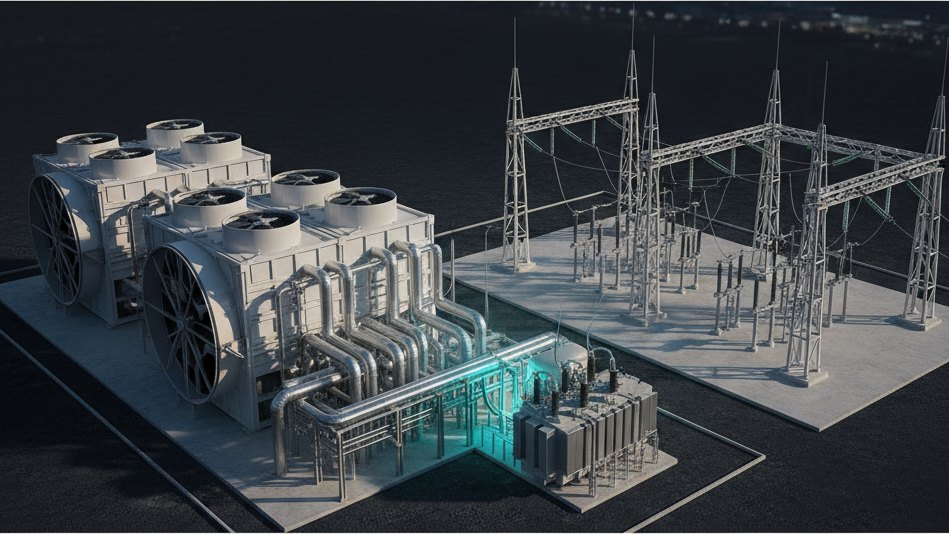
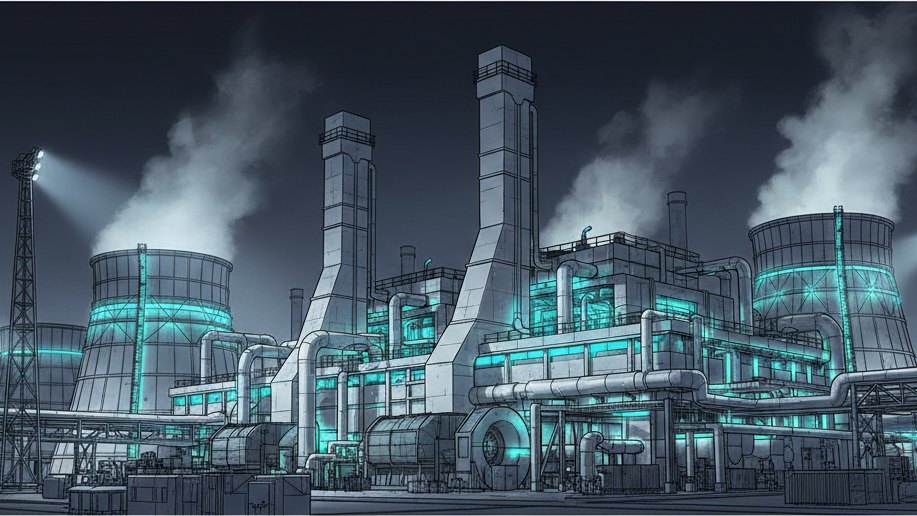
The global energy system currently functions as a massive heat-rejection mechanism with useful work as a secondary by-product. Of the approximately 600 exajoules of primary energy mobilized annually on a global scale, half or more is ultimately rejected as heat. This outflow, which manifests through cooling towers, flue stacks, and warm rivers, represents a scale of energy larger than the total consumption of any single nation. Within this estate, the industrial share is measured in thousands of terawatt-hours per year. For major economies, the recoverable fraction of this rejection is estimated in the hundreds of terawatt-hours, offering a resource that requires no new exploration or mining.
Historically, this vast resource has been ignored because of the term "waste heat." In technical and commercial contexts, waste is a verdict rather than a substance; it is the label applied to value that an economy has ceased to measure. This lack of exergy pricing has allowed civilization to overlook streams of energy that are already instrumented and mapped within plant historians. A single label currently bundles high-grade furnace exhaust, which carries significant work potential, with low-grade cooling water that carries very little. This failure to distinguish between quantity and quality through a proper ledger has resulted in a massive untapped energy source sitting idle at the industrial fence line.
Four primary forces are currently driving a shift toward the active recovery of this industrial estate. First, energy price volatility post-2022 has transformed heat recovery from a sustainability initiative into a necessary margin defense for industrial operators. Second, the technical toolkit has matured to include industrial heat pumps capable of reaching 150–200 °C, alongside standardized organic Rankine cycle (ORC) machines and thermal storage solutions that use inexpensive media like gravel. Third, the arrival of new neighbors—such as expanding district heating networks and liquid-cooled data centers—provides immediate sinks for recovered energy. Finally, new legal frameworks, including the European Union's mandated energy assessments and specific national obligations for waste heat offers, are creating the first formal "land registry" for this energy estate.
Would you like the summary and analysis of the next segment, which covers the temperature ledger and the distinction between energy and exergy inventories?
The Temperature Ledger and Grading
A megawatt-hour of rejected heat can be worth almost as much as electricity or almost nothing, with temperature being the single variable that decides its value. The thermodynamic ranking of the industrial estate requires a transition from a first-law energy inventory, which frequently misleads by grouping disparate streams under the label of "waste," to an exergy-based temperature ledger. This ledger converts a cooling-load schedule into a functional asset register by grading every stream according to its work potential.
The Carnot Column
The decisive instrument for this grading is the Carnot factor, defined as (1 − T₀/T), where T is the absolute temperature of the heat stream and T₀ is the environment temperature. This factor defines the exergy content, or the actual work potential, of heat. When this thermodynamic filter is applied, the site inventory is re-ranked dramatically:
- 1,000 °C furnace exhaust carries approximately 77% of its energy as work potential.
- 400 °C flue gas carries approximately 56% work potential.
- 150 °C exhaust carries approximately 30% work potential.
- 60 °C cooling water carries approximately 10% work potential.
- 35 °C return water carries approximately 3% work potential.
The Carnot column routinely demotes the warm-water headlines favored by energy audits and promotes ignored flue streams. Recovery capital, effort, and contracts should follow this exergy column rather than the energy one, as the exergy inventory identifies where the real business opportunity resides.
The Three Bands of the Estate
To organize the recovery toolkit, the estate is divided into three functional working bands based on temperature grade. Mixing the economics of these bands is identified as the most common appraisal error in heat recovery projects.
| Band | Temperature Range | Characteristics and Toolkit |
|---|---|---|
| High Grade | >400 °C | Power-generation quality (steam cycles, sCO₂). Includes furnace exhausts and hot products. Every recovery verb is applicable. |
| Medium Grade | 100–400 °C | The industrial workhorse band. Suitable for steam raising, organic Rankine cycles (ORC), and absorption cooling. |
| Low Grade | <100 °C | The estate's energy majority but exergy pauper. Includes cooling circuits and data-centre water. According to Forman’s accounting, this represents over 60% of the world's rejected heat. |
Matching and Limitations
The grading system serves four essential matching rules designed to prevent the destruction of exergy. First, grade must be matched to duty, reserving high-grade streams for high-duty requirements. Second, grade must never be quenched before the fence; for example, cooling a 900 °C stream to 90 °C to "recover" it as warm water annihilates the asset's value. Third, pinch analysis must be used to set targets before capital is spent. Finally, heat must be priced with a temperature clause; a contract per megawatt-hour without such a clause is equivalent to buying currency without asking which one.
The Five Verbs of Recovery
The technical toolkit for monetising the industrial heat estate is organized into five specific "verbs." Each verb represents a distinct thermodynamic strategy with a known window of temperatures, distances, and economics. By applying these verbs in sequence, an exergy audit converts a site’s cooling-load schedule into a viable asset register.
Verb One: Use
The most cost-effective recovery occurs where heat stands. This strategy employs internal recuperation and source-sink matching to pair every rejection with every demand the site already contains. The research literature identifies compatibility analysis as the core method here, using pinch analysis to set thermodynamic targets. By pairing sources and sinks based on grade, schedule, and distance, this method often discovers a second stratum of matches that a standard energy inventory misses—such as small hot streams serving high-grade duties.
Verb Two: Move
Heat that cannot be consumed on-site can often be transported to neighbors. At the park scale, industrial symbiosis allows one firm’s rejection to serve as a neighbor’s supply. For wider distribution, district networks are the proven channel, with transport costs typically ranging from 1–3 €/MWh·km at scale. The primary failure mode for this verb is organisational rather than thermal, requiring a park-level ledger to manage the map of rejections within pipe reach of networks.
Verb Three: Upgrade
This verb is the toolkit’s growth franchise, focusing on the estate’s low-grade majority (streams below 100 °C). Using industrial heat pumps and Mechanical Vapour Recompression (MVR), operators can lift these cool streams to serviceable supply grades. The economic logic is simple: recover warm and lift little. Because every degree already present in the waste stream reduces the compressor work that must be purchased, the low-grade estate acts as the heat pump fleet’s primary fuel.
Verb Four: Convert
When grade is present but local sinks are absent, heat is converted into electricity using steam cycles, organic Rankine cycles (ORC), or supercritical CO&sub2; (sCO&sub2;). This acts as an "export licence" for heat, allowing it to be sold to the grid. While thermodynamically honest above 100 °C, conversion is punished below that threshold due to single-digit Carnot ceilings. In a portfolio approach, conversion is often used seasonally, switching to power generation when heat demand saturates.
Verb Five: Store
Thermal storage bridges the gaps between rejection and demand schedules. By using thermal buffering with media available at "gravel prices" (euros per kilowatt-hour), sites can move heat from the hour of rejection to the hour of demand. This capability is often the deciding factor in whether a network contract is signable, as it converts intermittent pulses—such as furnace taps—into a steady baseload for the buyer.
Sectoral Mapping and Signature Streams
The global industrial estate is not a uniform field of rejection, but a concentrated map of specific opportunities where quantity finds the streams and quality finds the business. By applying a Carnot-graded inventory across major industrial classifications, recovery potential moves from a theoretical exercise to a targeted asset registry. The following sectoral profiles identify the signature streams where the first fortunes of the recovery economy are being made.
Heavy Industry: Steel and Cement
Iron and steel represent the estate's aristocracy due to their high-grade concentrations. The primary focus for recovery lies in off-gases and molten slag, the latter being a dense, barely-touched carrier of approximately 1.8 GJ per tonne at temperatures reaching 1,400 °C. While integrated mills have established practices for off-gas power and steam, the frontier of value lies in dry slag granulation to capture this high-density exergy. As the sector electrifies through EAF and hydrogen-DRI routes, these streams remain vital, defending the "green premium" of the finished product.
In the cement sector, the opportunity is defined by preheater exit gases and clinker cooler air, typically residing in the 250–400 °C band. This sector serves as the recovery toolkit’s clearest proof of concept, with an existing global fleet of Organic Rankine Cycle (ORC) and steam-bottoming installations proving the bankability of this temperature band. Because modern kilns already utilize internal cascading, the residual estate is naturally shaped for power conversion or raw-meal drying integration.
Process Industries and New Urban Nodes
Chemicals and refining constitute the largest aggregate estate on the map. This sector is characterized by reactor cooling, distillation condensers, and fired-heater flues spread across every thermal band. The "MVR revolution"—utilizing Mechanical Vapour Recompression in separations and distillation—is currently electrifying the steam band that was previously served by fossil combustion. Because a refinery is essentially a heat-exchange economy, the primary recovery strategy involves pinch retrofits to identify the second stratum of internal matches that modern exchangers have made profitable.
Data centres represent the fastest-growing wing of the estate. Unlike heavy industrial sites, these facilities offer constant, urban, and liquid-cooled streams in the 45–70 °C range. These characteristics provide what are termed the "easiest contracts" in the recovery economy. Because the counterparties are highly capitalized, reputationally motivated, and already instrumented, these constant flows are ideal for anchoring district heating networks via modest heat-pump lifts.
Sectoral Opportunity Matrix
| Sector | Signature Stream | Typical Grade | Primary Recovery Verb |
|---|---|---|---|
| Steel | Molten Slag / Off-gases | 1,200–1,400 °C | Recuperation & Conversion |
| Cement | Kiln / Cooler Exhaust | 250–400 °C | Convert (ORC/Steam) |
| Chemicals | Distillation Condensers | 80–150 °C | Upgrade (MVR/Heat Pump) |
| Data Centres | Liquid Cooling Loops | 45–70 °C | Move (District Networks) |
The transition of these sectors depends on moving beyond a first-law inventory. When a 1,400 °C slag stream is filed under "disposal" rather than as a 1.8 GJ/tonne asset, the organizational failure precedes the thermodynamic one. Mapping the estate by these signature streams allows recovery capital to follow the exergy column rather than the energy one.
The Audit-to-Contract Pipeline
The transition from identifying industrial thermal outflows to securing revenue requires a rigorous commercial framework. This transition is managed through a five-station process designed to convert raw plant data into bankable assets. The pipeline begins with the exergy audit, which utilizes the five-carrier inventory (flue, water, product, vapour, and letdown) to grade every stream by its Carnot factor. Unlike a standard energy audit, this phase resolves schedules and temperatures to reveal the true work potential of the estate. The second station is the match book, a compatibility analysis where sources are systematically paired to sinks—prioritizing internal recuperation before looking toward industrial parks or district networks. Following this, verb selection applies the appropriate recovery method (use, move, upgrade, convert, or store) based on specific temperature windows and dispatch logic. The process concludes with the business case—addressing capital, revenue, and carbon value—and finally, the contract.
A significant challenge in this pipeline is the allocation of boundary risk. Industrial site owners are often hesitant to take on the obligations of a utility, as heat recovery is rarely their core business. To remedy this, the commercial framework requires an intermediary, such as an Energy Service Company (ESCO) or a utility, to sit between the producer and the buyer. This intermediary owns the boundary assets—including heat exchangers, pumps, lifts, and storage—and absorbs the cross-default risk. This structure allows the industrial seller to monetize a byproduct without the burden of utility-shaped performance guarantees, a model that has successfully unlocked numerous deals in Nordic markets.
Commercial Instruments and Pricing
Effective heat commerce relies on standardized instruments that reflect the thermodynamic reality of the resource. Pricing must be transparently linked to quality; therefore, contracts should specify rates per MWh but include a "temperature clause". This clause ensures that the price of a rejected megawatt-hour rises with its grade, typically indexed against the buyer's best alternative at the delivered temperature. Without this indexation, a buyer is essentially purchasing currency without knowing its denomination.
| Contract Type | Primary Function | Key Provisions |
|---|---|---|
| Heat Offtake Agreement | Governs the direct sale of thermal energy. | Temperature clauses, availability guarantees, and step-in rights. |
| Intermediary Structure | Moves assets to utility-shaped balance sheets. | Ownership of exchangers/pumps, management of cross-default risk. |
| Park Ledger Compact | Facilitates multi-party industrial symbiosis. | Metering at grade, priority rules, and exit provisions for park tenants. |
Remedying Organizational Barriers
The primary obstacles to large-scale heat recovery are rarely technical; they are organizational. Barriers such as split incentives (where rejection and demand are managed by different departments or companies) and horizon mismatch (where industrial plants plan for quarters while networks plan for decades) have historically stifled projects. These are remedied through standard contracts and policy mandates. For instance, contract lengths can be tailored to match the transition pathway of a specific industrial asset, while intermediary financing converts a plant's ten-year payback period into an immediate signature and revenue line. By mandating temperature-graded inventories and heat-planning duties, policy can turn these organizational hurdles into a transparent land registry of energy opportunities.
Objections and the End of Waste Heat
The transition toward a recovery-based industrial economy faces five recurring objections that often stall projects during the appraisal phase. Addressing these concerns is not merely a matter of technical clarification but of formalizing the answers into contract clauses. By treating industrial rejection as a resource rather than a disposal problem, the recovery economy can be realized through the maturation of one profession, three standard contracts, and a mandated survey.
Addressing Industry Concerns
A primary objection suggests that if heat recovery were truly profitable, industry would already be practicing it. This "efficient-markets" view fails to account for the fact that markets only optimize what is priced and organized. Historically, industrial heat has lacked a meter at grade, a standard contract, and a clear internal owner. Where these organizational barriers are repaired—such as in Nordic district networks or cement-sector power fleets—recovery has become standard, profitable practice. Consequently, every project proposal must lead with an organizational remedy rather than a technical specification.
Critics also argue that recovery entrenches fossil fuel processes. However, recovery is a permanent feature of any thermodynamic economy, as electrified processes, data centers, and green-steel plants continue to reject significant heat. The remedy is to match contract lengths to a source's specific transition pathway. Furthermore, the concern that electrification will cause the estate to vanish is self-limiting; while the estate of 2040 will be cleaner and lower-grade, it will not be small. The strategy is to invest in shift-proof assets—such as networks, heat pumps, and storage—that can serve any source regardless of the primary energy carrier.
Financial and Professional Outlook
The mismatch between industrial payback horizons and heat recovery lifecycles is a significant hurdle. Industrial capital often demands three-year hurdles, whereas heat assets earn utility-shaped returns over much longer periods. The future of the sector relies on moving these assets onto utility-shaped balance sheets through intermediary ESCO structures. These intermediaries absorb the boundary and cross-default risks, allowing the industrial plant to sell a by-product without assuming the obligations of a utility provider.
The ultimate professional realization of this field depends on the distinction between quantity and quality. While a first-law energy inventory can identify large flows, only an exergy inventory using the Carnot column can find the business. Quantity finds the streams, but quality (exergy) finds the revenue. The path forward requires a mandated, temperature-graded inventory of the industrial estate, providing a land registry of heat that allows the market to run itself.
| Objection | Remedy / Design Rule |
|---|---|
| Efficient Markets (Industry would already do it) | Repair the organization first; profitability follows pricing. |
| Fossil Entrenchment | Match contract length to the source's transition pathway. |
| Shrinking Estate (Electrification) | Favour shift-proof assets like networks and storage. |
| Payback Horizons | Use intermediaries to move returns to utility-shaped balance sheets. |
| "Big Flows are Obvious" | Use exergy to find business value; energy quantity alone is misleading. |
The phrase "waste heat" should retire as a serious engineering term. As civilization learns to survey this resource, every cooling tower serves as a resignation letter from the first law, while the same plume, if properly graded and matched to sinks, represents a prospectus for the recovery economy.
Key findings
- Dominance of Low-Grade Heat — Over sixty percent of the world's rejected heat resides below 100 °C, making heat pumps and networks the primary recovery tools.
- Slag Exergy Density — Molten slag in the steel industry carries ~1.8 GJ per tonne at 1,400 °C, representing a dense but largely untapped resource.
- Transport Economics — District heat transport at scale costs between 1–3 € per MWh·km, defining the geographic limits of 'moving' heat.
- Steelworks Potential — A worked example of a mid-sized steelworks identifies €12–14M in annual value across streams previously considered disposal costs.
Method and assumptions
The paper uses an exergy-based compatibility analysis, applying the Second Law of Thermodynamics to industrial process data typically found in plant historians. It employs the Carnot factor (1 − T₀/T) to grade heat streams by quality rather than just energy quantity. Data is synthesised from global energy flow mappings (Cullen and Allwood) and dedicated waste heat accounting (Forman et al.). The 'Five Verbs' framework is an operational model for selecting recovery technologies based on temperature windows, distances, and economic hurdles. The work assumes standard environmental temperatures (T₀) of 25 °C for reference calculations.
Where it applies
- Industrial Park Symbiosis — Using a park-level exergy ledger to match steam cascades or heat rejections between adjacent manufacturing facilities.
- Data Centre Heat Offtake — Connecting liquid-cooled data centres to urban district heating networks using modest heat-pump lifts.
- Remote Smelter Power Recovery — Converting high-grade off-gas heat into electricity to displace expensive diesel generation at isolated mining sites.
Terms used
- Carnot Factor — The ratio (1 − T₀/T) representing the maximum theoretical efficiency for converting heat at temperature T into work.
- Pinch Analysis — A methodology for minimising energy consumption by calculating thermodynamically feasible energy recovery targets within a process.
- MVR (Mechanical Vapour Recompression) — An open-cycle heat pump process that compresses low-pressure vapour to a higher pressure and temperature for reuse.
- ORC (Organic Rankine Cycle) — A thermodynamic cycle using high-molecular-mass organic fluids to convert medium-grade heat into work.
- Exergist — A professional discipline focused on the preservation and management of work potential in energy systems.
Questions and answers
Why is the Carnot factor more important than the energy total in a heat audit?
The Carnot factor identifies the quality or 'work potential' of the heat. Because a 1,000 °C stream has ~77% work potential and 35 °C water has ~3%, recovery capital should follow the exergy column to avoid spending high-value investment on low-value streams.
How do you handle the risk of an industrial plant shutting down after a network invests in its heat?
The paper proposes a 'step-in' clause in the offtake agreement, allowing an intermediary or utility to take control of boundary assets or secure alternative supply, alongside contract terms matched to the source's transition pathway.
Can low-grade heat (<100 °C) be used for anything besides heating buildings?
Yes, it acts as the 'fuel' for industrial heat pumps. Every degree present in the waste stream is a degree the compressor does not have to lift, significantly improving the Coefficient of Performance (COP).
What is the primary barrier to these projects if the technology exists?
The barriers are organizational: split incentives between departments, horizon mismatches between industrial and utility capital, and the lack of a standardized heat offtake contract with a temperature clause.
How to cite
Bakker, W. A. (2026). Waste Heat Is Not Waste: The Global Exergy Opportunity in Industry. Exerginity White Paper Series, No. 7, First edition. Exerginity.