The Three Axes of Storage Judgment
Every storage technology is defined by three primary coordinates: the quality of energy that survives the round trip, the specific durations over which the system operates, and the distinct cost structures of power and capacity. Evaluative metrics for these systems must move beyond simple nameplate capacity, which often masks the actual work potential preserved during operation. Identifying these axes allows for a portfolio approach where technologies are assigned based on physics rather than a search for a single champion.
Axis One: Round-Trip Exergy Retention
Round-trip exergy retention measures the work potential delivered on discharge relative to what was absorbed during charging. To avoid marketing distortions, this metric must be quoted from duty-in to duty-out, reflecting the specific carrier required by the end use. When evaluated on an electricity-to-electricity basis, the retention ranges vary significantly across technologies:
- Batteries: 85–95%
- Pumped Hydro: 70–85%
- Adiabatic Compressed Air: 60–70%
- Carnot Batteries: 40–70%
- Hydrogen Chains: 30–45%
Notably, thermal stores serving heat at their stored grade can achieve 85–95% retention because they avoid the exergy destruction inherent in conversion.
Axis Two: Dual Duration
Duration must be understood in two distinct senses to accurately judge a system's eligibility for a specific role. Discharge duration, calculated as energy capacity divided by power rating, defines the system's duty, such as daily solar shifting or multi-day weather resilience. Holding duration defines how long the stored value survives standing losses. While flywheels may leak their charge in hours and batteries lose a few percent per month, chemical stores like hydrogen in caverns can hold energy indefinitely. Misunderstanding these dimensions leads to errors such as proposing batteries for seasonal "winter" storage, where standing losses and cycle costs become prohibitive.
Axis Three: The Cost Split
Economic evaluation requires separating the cost of power (the converters) from the cost of capacity (the medium). These two costs scale differently depending on the technology family:
| Technology Type | Cost Structure | Economic Advantage |
|---|---|---|
| Batteries | Bundled capacity and power | Short duration (high cycle frequency) |
| Pumped Hydro / Hydrogen | Decoupled capacity and power | Long duration (low commodity/civil costs) |
| Thermal Media | Decoupled capacity and power | Bulk heat (lowest medium cost) |
Batteries are efficient but expensive as the duration increases because every added hour requires purchasing more of the integrated medium. In contrast, decoupled systems like hydrogen or thermal storage add capacity at the price of civil works or raw commodities, making them the natural choice for long-duration applications.
Would you like the summary of the next section, which covers the physics of storing work?
Audit of the Four Storage Families
A rigorous technical review of storage options reveals that no single technology dominates all performance metrics. Instead, the landscape is divided into four distinct families—electrochemical, mechanical, thermal, and chemical—each defined by its specific trade-offs between exergy retention, duration capabilities, and cost structures. Selecting the appropriate system requires matching these physical characteristics to the specific requirements of the duty cycle.
Electrochemical Systems: The Quality Vault
Electrochemistry represents the premier "quality vault" for the energy economy, characterized by the highest round-trip exergy retention for electricity-to-electricity duties, typically ranging from 85% to 95%. Because these systems move ions between host structures at potentials close to equilibrium, they avoid the steep thermodynamic tolls associated with thermal conversion. However, this high performance comes with a specific "cycle-life rent." The exergy asset itself erodes over time through chemical degradation, making the cost per cycle a critical metric.
- LFP and Sodium-ion: These chemistries are increasingly favored for grid stability and daily shifting. Lithium Iron Phosphate (LFP) offers superior cycle life (6,000–10,000 cycles) compared to high-density alternatives, while Sodium-ion provides a hedge against lithium supply chain volatility.
- Limitations: Because batteries bundle power and capacity within the cell, they face a ruinous economic ceiling for long-duration applications. They are optimized for sub-daily duties where high frequency and high retention justify the investment in expensive media.
Mechanical Systems: Bulk Carriers and Geographic Taxes
The mechanical family utilizes nearly-free media—water, air, and mass—to store work potential. These are the "bulk carriers" of the grid, capable of holding vast quantities of energy for months with minimal standing loss. Their primary constraint is not the cost of the medium, but a "geographic tax," as systems like pumped hydro and Compressed Air Energy Storage (CAES) require specific geological formations.
| Technology | Retention | Technical Characteristic |
|---|---|---|
| Pumped Hydro | 70–85% | Decoupled power/capacity; provides synchronous inertia. |
| Adiabatic CAES | 60–70% | Efficiency depends entirely on the capture of compression heat. |
Thermal Systems: The Under-priced Giant
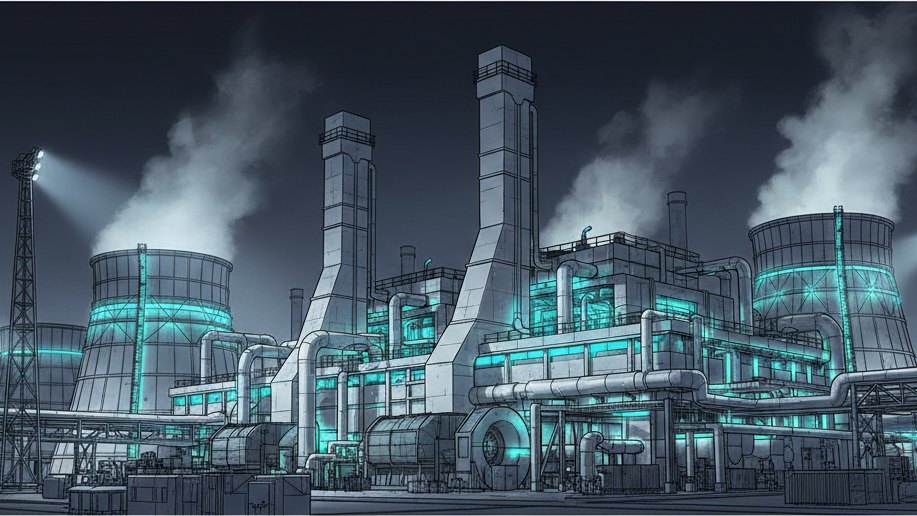
Thermal storage is often overlooked because it is measured in heat rather than electricity, yet it serves the half of final energy demand that is thermal in nature. By using media such as sand, salt, or water—priced at "gravel prices" of €1–10/kWh—these systems offer virtually unlimited cycle life. When the "grade discipline" is maintained (storing heat at the temperature of its intended use), these systems achieve 90%+ retention because they bypass the losses of conversion.
Chemical Systems: Indefinite Seasonal Reserves
Chemical storage, primarily involving hydrogen and its derivatives, represents the only family capable of unbounded scale and indefinite holding. While it suffers the harshest round-trip tolls (returning only 30–45% of entrusted exergy), its unique ability to hold value across seasons without standing loss makes it the only viable candidate for strategic reserves and long-term stockpiles. In a balanced portfolio, chemistry acts as the "fire brigade"—rarely cycled but indispensable for surviving multi-week weather events where other families would be exhausted or economically unviable.
Would you like the summary of the next section covering the contested long-duration tier and the portfolio theorem?
The Long-Duration Energy Storage (LDES) Contest
A critical gap exists in the storage landscape between short-term electrochemical balancing and the indefinite holding capacity of chemical fuels. This contested middle ground, typically defined by discharge durations of 8 to over 100 hours, serves a specific systemic necessity: the mitigation of weather-related renewable shortfalls. While lithium-ion systems excel at daily solar shifting, they cannot economically address multi-day atmospheric events like the Dunkelflaute. Conversely, while seasonal chemistry offers unbounded duration, it is often oversized for these intermediate intervals. Consequently, this tier has become a primary arena for technological competition, where viability is determined by the ability to provide reliable capacity during infrequent but prolonged periods of low generation.
The contenders for this duty represent diverse physical mechanisms, each offering a different set of trade-offs on the exergy ledger. Flow batteries, which decouple power and energy by storing electrolyte in external tanks, are prominent in the 8-to-24-hour range, typically achieving round-trip exergy retention of 65–75%. Mechanical systems, such as adiabatic compressed air energy storage (CAES), utilize nearly-free media to provide bulk capacity, though their performance hinges on the efficient preservation of compression heat. For the longest durations within this band, iron-air systems and other metal-air chemistries trade lower retention rates for extremely low-cost media, essentially offering capacity at the price of common minerals. As durations stretch toward the 100-hour mark, cavern-based hydrogen and other chemical stores begin to dominate due to their superior holding characteristics.
The economic logic of the LDES tier differs fundamentally from the daily arbitrage cycles of shorter-term storage. Because these assets may only cycle dozens of times per year rather than hundreds, their financial sustainability cannot rely on pure energy arbitrage. Instead, economic viability depends on capacity remuneration and reliability contracts that value the store as a form of system insurance. This shift in valuation acknowledges that the primary product of a long-duration asset is the guarantee of availability during renewable droughts, making the cost per unit of capacity more decisive than the cost per unit of power.
Currently, most technologies in this category are navigating a difficult commercial transition. They frequently cluster in a "valley of death" between high technical readiness (TRL 7–9), where the physics is proven, and lower commercial readiness (CRI 2–4), where bankability remains unestablished. To bridge this gap, procurement must move beyond simple efficiency metrics and evaluate candidates based on their specific performance under the buyer's actual weather-driven cycle profiles. The winner of this contest will not be a single "best" technology, but rather the set of solutions that best align with specific geographic constraints and regional reliability requirements.
Would you like a summary of the next segment, which covers the Portfolio Theorem?
The Portfolio Theorem and System Integration
A fundamental principle of exergy-based planning is that a least-cost decarbonised energy system must be constructed as a layered architecture of diverse storage technologies. No single technological breakthrough or cost decline can repeal the physics-based necessity of this layering. Storage solutions are categorized by their specific duties, which are defined by discharge duration, cycle frequency, and the grade of energy required by the end-user. Because the three primary axes of judgment—retention, duration, and cost—trade against each other by physical law rather than mere technical immaturity, a diverse portfolio is the only path to system stability.
Integrated storage must compete against two formidable non-storage rivals: transmission and flexible demand. Transmission functions as a "spatial store" with approximately 95 percent retention, moving energy across weather systems with no holding limit. Meanwhile, flexible demand represents storage at the price of software, shifting loads to match availability. For any physical storage asset to be bankable, its exergonomic value must exceed the cost of these alternatives.
The Role of Curtailment and Duty Stacking
In high-renewable systems, curtailment acts as a "free fuel" for the storage portfolio. This zero-cost margin favors interruption-tolerant tiers, specifically thermal and chemical storage, which can absorb irregular surges of excess exergy that might otherwise be refused by the grid. By utilizing curtailment, these technologies can overcome lower round-trip retention through reduced input costs.
The system roles within a balanced portfolio stack according to specific temporal and form-based requirements:
- Electrochemistry: Batteries are the quality vault for intra-day duties, providing high retention and millisecond reflexes for solar shifting and grid stability.
- Mechanical: Pumped hydro and compressed air serve as the bulk carriers for daily-to-weekly durations, utilizing low-cost media where geography permits.
- Thermal: This tier serves the heat half of total energy demand, storing exergy at the grade of use (such as industrial steam or district heating) to avoid the tolls of unnecessary conversion.
- Chemistry: Hydrogen and other molecular stores provide duration without limit, acting as the system’s "fire brigade" or strategic reserve for winter and long-duration weather droughts.
By stating the duty first and matching it to the appropriate family, system designers minimize conversions and maximize the kilowatt-hours of exergy preserved across time.
Would you like a summary of the next section, which covers the exergonomics of storage and corrected cost metrics?
Exergonomics: Correcting Storage Metrics
The transition from a fossil-based system to a renewable one requires a fundamental shift in how we price and procure flexibility. While the previous era relied on geological accidents of chemical exergy stored in reservoirs, the modern grid must rebuild this resilience deliberately. However, current financial frameworks often rely on "first-law" blind spots that obscure the true value of different storage technologies. To achieve honest procurement, the financial and material ledgers must be adjusted to account for the quality, not just the quantity, of energy preserved over time.
Correcting LCOS for Exergy and Carbon
The standard industry metric, Levelized Cost of Storage (LCOS), typically divides lifetime costs by lifetime energy discharged. This calculation is fundamentally flawed because it treats all megawatt-hours as equals, regardless of their grade. A robust exergonomic approach requires three critical corrections to the LCOS formula:
- Exergy Denomination: Discharge must be denominated in exergy rather than energy. This restores the ranking of technologies by accounting for the grade of the output; for instance, it prevents the misgrading of thermal storage by recognizing the difference in work potential between high-grade industrial steam and low-grade heat.
- Charge Cost and Carbon: The ledger must explicitly state the cost and carbon intensity of the charging exergy. A store cycling on "free" curtailed wind has a vastly different economic and environmental profile than one cycling on peak-hour fossil generation.
- Quality Arbitrage: By pricing the discharge in exergy, the metric identifies the "quality arbitrage" performed by the asset—buying low-value hours and selling high-value, high-stability services.
Pricing Capacity for Seasonal Resilience
For long-duration and seasonal storage, energy arbitrage alone is often insufficient to create a bankable business case. Technologies like hydrogen caverns or large-scale thermal reservoirs may cycle only a few times a year, meaning they "starve" on a per-kilowatt-hour revenue model. To make these essential reserves financeable, capacity value must be priced alongside energy value. These assets function as the system's "fire brigade"—indispensable for the worst weather events, such as a windless winter fortnight. Pricing them as insurance rather than simple energy traders allows the market to value their unbounded holding capabilities and strategic resilience.
The Embodied Ledger and ESOI
Honest procurement also requires closing the account on the materials used to build storage assets. The metric of Energy Stored on Invested (ESOI) measures the lifetime exergy delivered against the embodied exergy invested in the hardware. On this ledger, geological and thermal media rank significantly higher than batteries, often by an order of magnitude, due to their use of abundant, low-embodied-exergy materials like water, salt, or gravel and their nearly unlimited cycle lives.
For electrochemical systems, where ESOI is lower, the material shadow is more pronounced. In this context, battery management software is characterized as a "materials policy" rather than a mere technical utility. Because software dictates the depth of discharge and thermal environment, it directly controls the cycle life of the cells. Extending the life of a battery through sophisticated management effectively reduces its material footprint and improves its standing on the embodied ledger, tying procurement directly to long-term material loops.
Selection Framework: The Right Store for the Right Duty
Establishing a rigorous selection framework requires practitioners to move beyond nameplate capacity and state the specific duty of a storage application before considering technology. This definition must be anchored in three primary parameters: the carrier required (whether the end-use demand is for electrons, heat at a specific grade, or molecules), the required discharge duration, and the anticipated frequency of cycles per year. By formalizing these requirements, the selection process shifts from a search for a universal "champion" technology toward an exercise in duty assignment based on physical and economic eligibility.
The fundamental design heuristic for any storage system is to minimize conversions and store energy at the grade of use. Every change in energy form—such as converting electricity to hydrogen and back—incurs multiplicative tolls that degrade the exergy surviving the round trip. Consequently, thermal storage at grade is the rational choice for the approximately fifty percent of global final energy demand that consists of heat. When heat is stored and served at its working temperature, such as industrial steam or district heating, it achieves retention rates of 85–95 percent because it avoids the efficiency penalties of converting back to electricity. Thermal media, including sand, water, and salt, offer the lowest capacity costs in the portfolio, making them the exergy-rational vault for thermal duties across all timescales.
For high-duration requirements that exceed the economic limits of batteries, chemistry provides the only solution for unbounded holding. Chemical storage, such as hydrogen in salt caverns, serves as the system’s "fire brigade." It is sized by the "worst fortnight"—the rare, multi-day weather events where renewable generation fails—and must be priced as insurance rather than through simple energy arbitrage. While chemical chains suffer the harshest round-trip exergy tolls, their nearly zero standing losses and low commodity-scale capacity costs make them the only viable candidates for seasonal and strategic reserves.
Assigning technologies based on these axes ensures that each asset is utilized where its specific strengths outweigh its inherent limitations. Electrochemistry remains the quality vault for sub-daily electrical duties where high retention is paramount. Mechanical and long-duration contenders address the multi-day bulk tier, while molecules are reserved for feedstocks and seasonal resilience. By matching the technology to the stated duty, practitioners can build a layered portfolio that preserves the maximum amount of work potential across time.
Key findings
- Thermal Storage Value — Thermal media such as sand and salt store energy at single-digit euros per kWh, achieving 90% retention when the grade discipline is maintained.
- The Battery Duration Ceiling — The integrated cost of battery cells creates an economic ceiling (currently 6–12 hours) where decoupled systems like flow batteries or CAES become more competitive.
- Hydrogen's Strategic Role — Despite a low 30–45% round-trip retention, hydrogen is the only technology capable of unbounded seasonal holding, functioning as a system 'fire brigade'.
- Exergy Preservation as Progress — The paper posits that the true unit of progress in the energy transition is the kilowatt-hour of exergy preserved through space, form, matter, and time.
Method and assumptions
The paper uses an exergy-based auditing method to evaluate energy storage systems. It moves beyond first-law thermodynamics (energy quantity) to second-law analysis (energy quality/work potential). The author employs a multi-axis framework—retention, duration, and decoupled cost structures—to evaluate literature ranges for various technologies. System-level assumptions include a transition from 'geological accident' storage (fossil fuels) to 'designed' storage in renewable-heavy grids. The analysis incorporates the 'Energy Stored on Invested' (ESOI) metric and the 'Commercial Readiness Index' (CRI) to distinguish between physical possibility and bankable asset status.
Where it applies
- Grid-Scale Procurement — Applying the ten-question checklist to compare unlike technologies like iron-air batteries versus pumped hydro on a common exergy ledger.
- Industrial Decarbonisation — Utilizing high-grade thermal storage (sand/salt) to buffer curtailed solar for industrial steam requirements at 90% retention.
- Seasonal Resilience Planning — Sizing chemical storage (hydrogen/ammonia) as a capacity-based 'strategic stockpile' for multi-week wind droughts (Dunkelflaute).
Terms used
- Exergy Retention — The ratio of exergy delivered on discharge to the exergy absorbed on charge, measured at the store's terminals.
- Carnot Battery — A system that stores electrical energy as heat via a heat pump and returns it as electricity through a heat engine.
- Dunkelflaute — A German term used in the energy industry to describe a period of low wind and solar output, typically lasting several days.
- ESOI — Energy Stored on Invested; the ratio of lifetime exergy discharged by a store to the embodied exergy required to build it.
- Adiabatic CAES — Compressed Air Energy Storage that captures and stores the heat of compression to be reused during the expansion stage, improving efficiency.
Questions and answers
Does efficiency matter if the charging energy is free curtailment?
While curtailment lowers the cost of losses at the margin, low-retention stores still consume more system capacity per unit delivered. The 'free-fuel' argument justifies seasonal hydrogen storage but does not validate low-retention chains for daily duties where batteries are available.
Can batteries ever be used for seasonal storage if they become cheap enough?
No; the paper argues that cell-cost declines cannot annex seasons because batteries suffer from calendar leakage and the 'once-a-year cycle' problem, which makes them economically unviable compared to chemical stores.
Why is thermal storage considered 'under-priced'?
Thermal media like sand or gravel cost orders of magnitude less than battery chemicals (€1–10/kWh vs hundreds). When used to serve heat demand directly at the stored grade, they bypass the conversion tolls that penalize other storage types.
How should Long-Duration Energy Storage (LDES) be financed?
Because its duty is intermittent and focused on rare weather events, LDES cannot rely on energy arbitrage alone. It requires revenue stacking from capacity remuneration, reliability contracts, and ancillary services like inertia.
How to cite
Bakker, W. A. (2026). The Exergy of Energy Storage: Comparing Batteries, Hydrogen, Thermal Storage and Long Duration Storage. Exerginity White Paper Series, No. 5. First edition. Published by Exerginity.