Thermodynamic Context: Quality vs Quantity
The prevailing discourse regarding the energy impact of artificial intelligence is almost exclusively conducted in kilowatt-hours. Whether the sentiment is one of alarm over massive grid demands or reassurance regarding efficiency gains, both sides of the debate typically focus on the quantity of energy consumed. However, from the perspective of the second law of thermodynamics, the energy problem of AI is fundamentally a matter of quality. In thermodynamics, this quality is measured as exergy—the potential of energy to perform useful work. By evaluating AI through this lens, the data centre emerges as a unique and remarkable artifact of modern engineering: it is the purest large-scale exergy destroyer built by civilisation.
The mechanism of this destruction is total and immediate. An AI data centre consumes electricity, which is near-pure exergy and the highest-grade energy carrier produced by our energy system. Inside the facility, this premium work potential is converted almost entirely into heat. While other industrial processes—such as steel mills or chemical plants—embed a portion of their energy into ordered material or mechanical work, a data centre performs its function and rejects essentially one hundred percent of its input electricity as heat. This heat is typically discharged at temperatures the first-law world classifies as worthless, often just a few degrees above ambient. This process represents the total degradation of the grid's finest product into the lowest grade of heat the economy generates.
Traditional metrics used to evaluate data centre performance fail to capture this thermodynamic reality. The industry standard, Power Usage Effectiveness (PUE), measures the ratio of total facility energy to IT equipment energy. While a lower PUE indicates a more efficient cooling and power chain, the metric remains blind to several critical factors:
- Quality of Rejection: PUE treats all rejected heat as an overhead to be minimised rather than a resource. It cannot distinguish between a facility that vents lukewarm air into the atmosphere and one that provides high-grade hot water to a district heating network.
- Computational Efficiency: PUE assumes that all energy reaching the IT floor is "useful," ignoring the massive gap between current hardware performance and the physical limits of computation.
- Resource Timing: The metric does not account for when the energy is drawn from the grid, failing to reward the flexibility that could allow AI loads to support grid stability.
Establishing this distinction matters because the "exergy destruction" of AI is not merely a theoretical indictment; it is a technical diagnosis. Because this destruction is concentrated in instrumented buildings owned by the world’s most technically capable buyers, it is also the most correctable energy phenomenon in history. Recognising that AI consumes quality, not just quantity, allows for a shift in strategy: from simply consuming fewer kilowatt-hours to ensuring that every joule of high-grade exergy performs its work twice—first as a thought, and then as a useful thermal resource.
The Scale and Concentration of AI Load
Quantifying the energy appetite of artificial intelligence requires distinguishing between global aggregates and local intensities. According to the International Energy Agency (IEA), global data centre consumption stood at approximately 415 TWh in 2024, representing 1.5 percent of world electricity demand. However, this load is projected to rise to 945 TWh by 2030, eventually surpassing the national electricity consumption of Japan. While these figures represent a relatively minor share of global demand, the rate of growth is significant, at roughly twelve percent annually since 2017—four times the pace of total global electricity demand.
The geographic distribution of this load is highly concentrated. The United States currently hosts 45% of the global load, with China at 25% and Europe at 15%. Within these regions, the impact is further narrowed to specific counties and grid zones where AI campuses concentrate gigawatts of demand. In the United States, data centres are projected to account for nearly half of all electricity demand growth through 2030, at which point the sector will draw more power than the nation's combined production of steel, aluminium, cement, and chemicals.
This concentration creates decisive local constraints that transcend global averages. The primary scarcity facing the AI build-out is not generation capacity, but rather connection infrastructure. In advanced economies, connection queues for new campuses now stretch from four to eight years. These grid-related delays are significant enough that the IEA estimates approximately one-fifth of all announced data centre projects risk being stalled or postponed. Consequently, the energy challenge of AI is defined less by its total planetary quantity and more by its extreme concentration in space and its unprecedented speed in time.
| Metric | 2024 Estimate | 2030 Projection |
|---|---|---|
| Global Electricity Consumption | 415 TWh | 945 TWh |
| Share of World Electricity | ~1.5% | ~3.0% |
Projections for the end of the decade remain subject to variables such as algorithmic efficiency gains and hardware refresh cycles. Credible scenarios for 2030 range between 700 and 1,200 TWh. Regardless of the specific total, the concentration of these loads ensures that AI will remain the fastest-growing large electrical load on Earth, effectively turning these facilities into the fastest-growing sources of recoverable waste heat in urban environments.
The Physics of Computation: The Landauer Gap
Every answer produced by an artificial intelligence carries a thermodynamic price, yet the physical floor for that price is remarkably low. According to Landauer's limit, established in 1961, the unavoidable thermodynamic cost of erasing a single bit of information at room temperature is approximately 3 x 10^-21 joules. This figure represents the absolute minimum exergy that a logically irreversible operation must destroy. In the current landscape of silicon hardware, however, the distance between theoretical possibility and practical reality is vast. Modern accelerators and high-performance GPUs typically operate seven to nine orders of magnitude above this physical floor, spending between 10^-13 and 10^-12 joules per elementary operation. This discrepancy, often referred to as the Landauer Gap, represents a hundred-million-fold efficiency headroom that is unique to the field of computation.
The Efficiency Frontier
Unlike traditional industrial processes, computation is not restricted by a Carnot ceiling. Heat engines, motors, and chemical processes are bound by rigid thermodynamic limits that offer relatively little room for further improvement. In contrast, the massive gap between current silicon performance and Landauer's limit guarantees that operations per joule can continue to improve for decades. History supports this trajectory, as each successive hardware generation delivers several-fold improvements in efficiency through advances in architecture, device physics, and numerical precision, such as the shift from 32-bit to 8-bit arithmetic.
Heat as a Permanent Physical Fact
Despite these potential gains in efficiency, a fundamental physical reality remains: essentially one hundred percent of the electricity entering a processor is converted into heat. The thermodynamic content of the information produced—the "answer" itself—is so minuscule that it vanishes relative to the energy consumed. Consequently, a data center acts as a pure exergy destroyer, converting high-grade electricity into low-grade heat at a total yield. This leads to a critical understanding of AI infrastructure:
- Efficiency and recovery are not rivals: Even if chips become orders of magnitude more efficient, the energy they do consume will still be rejected as heat.
- The Landauer Gap is an inheritance: Every order of magnitude reclaimed from this gap represents a reduction in the number of power plants required to sustain global compute demand.
- Proximity drives density: The campaign against energy waste is increasingly fought by reducing the distance data must travel between memory and compute, leading to the extreme rack densities seen in modern AI campuses.
Because the conversion of electricity to heat is a permanent physical fact at any efficiency level, the challenge for engineers is to spend fewer joules per answer while ensuring that every joule spent is utilized twice—once for computation and once as a recoverable thermal resource.
The Liquid Cooling Transition and Heat Recovery
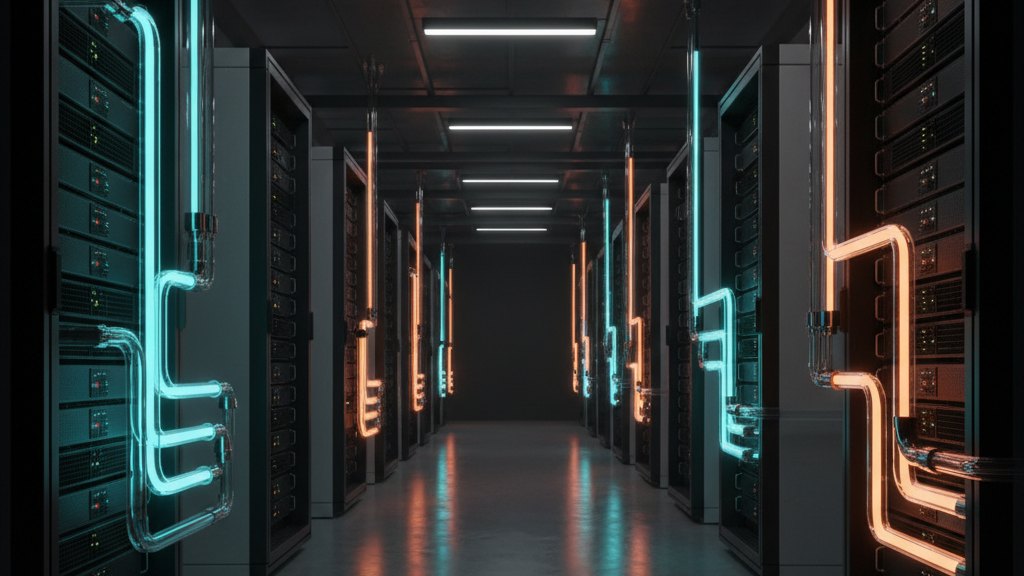
The thermodynamic profile of artificial intelligence is currently undergoing a fundamental shift driven by the physics of interconnects. As the industry pursues faster and cheaper communication between chips, rack densities have climbed from traditional levels of 10 kilowatts to between 120 and 130 kilowatts today. With next-generation systems announcing densities of 200 kilowatts and beyond, air cooling has reached its practical limits. Air-cooled halls typically exhale exhaust at 30–40 °C, a temperature range with near-zero exergy that is too cool for almost any secondary use. This density march has forced a widespread transition toward direct-to-chip liquid cooling for new AI construction.
Auditing the Cooling Chain
From a second-law perspective, liquid cooling is thermodynamically superior to the air-cooled systems it replaces. Water possesses a heat capacity thousands of times greater than air per unit volume, allowing operators to replace massive air-moving fans with more efficient pumps, thereby reducing parasitic work. Crucially, liquid systems allow chips to tolerate warmer coolants while returning water at 45–70 °C. This shift multiplies the exergy content of the waste stream, moving it from the category of thermodynamic refuse into district-heating territory. An audit of a reference 100 MW campus reveals that it rejects approximately 950 GWh of 55 °C heat annually. By the second law, the destruction of this heat represents the campus's largest energy loss after the chips themselves, yet it remains invisible to standard industry metrics like Power Usage Effectiveness (PUE).
The Emergence of the Waste Heat Estate
The global data centre fleet is effectively becoming the world's fastest-growing supply of recoverable low-grade heat. This "waste heat estate" is characterized by several high-value attributes:
- Constancy: Unlike intermittent solar thermal sources, data centres provide a continuous 24/7 load.
- Reliability: The heat supply is backed by the operator's own requirements for high uptime.
- Urban Proximity: Campuses are increasingly sited near population centers to satisfy latency and workforce requirements, placing them near potential heat customers.
Despite these advantages, the waste heat estate remains largely vacant. Currently, under 5% of global data centre heat is recovered, representing a massive unlet property in the energy economy. The obstacles to recovery are primarily contractual and geographical rather than thermodynamic. While projects in Stockholm and Odense have proven the commercial viability of warming thousands of homes with server heat, most of this resource is still discarded. Because the AI data centre converts nearly 100 percent of its high-grade electrical input into heat, recovery is a permanent frontier for the industry. However efficient the chips become, they will always function as concentrated urban heaters, making the establishment of heat offtake agreements a critical component of future energy policy.
Grid Integration and Supply Strategies
The binding constraint on the artificial intelligence buildout has shifted from the availability of silicon to the availability of electrical connection. With transmission interconnection wait times stretching to four to eight years in advanced economies and gigawatt-scale requests landing on utilities that previously planned for decimal growth, the queue itself has become the primary scarcity. The International Energy Agency (IEA) estimates that approximately one-fifth of announced data center projects now face significant delays due to grid limitations alone. In response, the role of private buyers in financing new energy infrastructure is rewriting the traditional rules of electricity procurement.
AI demand is accomplishing what decades of public policy could not: it has made firm, clean, round-the-clock power a product that private balance sheets are willing to underwrite. Hyperscalers are increasingly acting as the primary financiers for the next generation of carbon-free energy, bridging the commercial "valley of death" for capital-intensive technologies. This is most visible in the nuclear sector, where cumulative hyperscaler commitments are approaching 10 GW. High-profile examples include Microsoft’s contract to restart the retired Unit 1 reactor at Three Mile Island, Google’s partnership for a fleet of Kairos small modular reactors (SMRs), and Amazon’s investments in X-energy. These buyers are also the driving force behind 24/7 carbon-free energy contracting and the first commercial offtakes for advanced geothermal power.
Beyond acting as a source of capital for new supply, the AI load itself contains a massive, currently unpriced grid resource: software-speed flexibility. Unlike industrial smelters or residential blocks, AI workloads possess inherent temporal and spatial elasticity. Training runs are checkpointable, meaning they can be paused and resumed, while inference workloads can be routed across global sites to follow available capacity. This makes the AI fleet the decade's largest demand-response resource, capable of moving exergy demand at the speed of a scheduler. To resolve the queue crisis, some operators are already entering "curtailment-for-connection" bargains, where a campus accepts contracted flexibility and demand response in exchange for a prioritized position in the grid connection queue. Treating these campuses as flexible assets rather than inflexible blocks of load allows for the integration of gigawatts of compute without necessitating the immediate over-build of transmission infrastructure.
| Supply Strategy | Mechanism of Action | Grid Impact |
|---|---|---|
| Nuclear Underwriting | Private contracts for SMRs and reactor restarts (e.g., Three Mile Island). | Adds firm, zero-carbon baseload capacity financed by private buyers. |
| Load Flexibility | Utilizing checkpointable training and routable inference. | Provides a massive, unpriced demand-response resource for grid stability. |
| Connection Bargains | Trading queue priority for contracted demand response. | Accelerates deployment while reducing the need for immediate grid upgrades. |
Embodied Exergy and the Hardware Lifecycle
The operational kilowatt-hours consumed by data centers represent only the most visible portion of AI’s thermodynamic ledger. Behind every accelerator lies a supply chain that ranks as the most exergy-intensive manufacturing process per kilogram in industrial history. Advanced semiconductor fabrication plants (fabs) operate at a scale where they draw city-scale power to produce objects measured in grams. Much of this energy is directed toward extreme-ultraviolet (EUV) lithography, where machines consume roughly a megawatt each just to generate light. The process is further intensified by the need for cleanrooms with particle counts a thousand times stricter than surgical environments and the production of ultrapure water, which is refined at a significant exergy cost.
The lifecycle of this hardware is defined by a rapid, four-year river of retirement. Unlike traditional industrial assets, AI hardware is typically retired not due to physical failure, but because of efficiency gains. New generations of silicon offer such substantial improvements in operations per joule that older accelerators become economically and thermodynamically obsolete within three to five years. This results in a constant stream of decommissioned servers containing functional silicon and circuit boards rich in gold, palladium, tantalum, and copper. While this creates a rich feedstock for urban mining, much of the embodied exergy in these high-grade artifacts currently goes unbanked due to a lack of systematic collection.
The Compute Passport Proposal
To address the lack of transparency in the upstream environmental and energetic costs of AI, there is a formal proposal for a "compute passport." This ledger would track critical data throughout a piece of hardware's lifecycle, including:
- Embodied Carbon: Precise accounting of emissions from the fabrication and assembly phases.
- Critical Mineral Data: Tracking the use of gallium, germanium, rare earths, and copper to manage geographic chokepoints and fragility in the supply chain.
- Material Origin: Information to facilitate circular economy harvesting and disassembly at the end of the hardware's four-year service life.
This mechanism follows the precedent set by battery passports, providing the industry with a standardized handle to measure what a chip embodies versus what it consumes during operation. Without such a ledger, the true exergy cost of intelligence remains hidden behind the data center fence, leaving the industry's most exergy-dense artifacts to flow through the economy without proper accounting.
Policy Framework for the Computational Grid
The transition of the data centre from a specialized facility into a foundational component of energy infrastructure necessitates a regulatory response centered on second-law thermodynamics. As campuses begin to command gigawatt-scale interconnections, policy must move beyond quantity-based energy metrics to address the quality of exergy destruction and the systemic effects of concentrated demand. Regulating the AI sector effectively requires a transition from voluntary reporting to a structured policy kit focusing on disclosure, heat recovery, and grid integration.
Mandatory Campus-Level Disclosure
Effective management of the AI sector's growth is impossible without granular, campus-level transparency. Policy should mandate a standard disclosure template—a "compute passport"—for all large-scale facilities. This framework requires the public reporting of energy consumption, Power Usage Effectiveness (PUE), Water Usage Effectiveness (WUE), and reject temperature curves. Furthermore, reporting must include data on heat reused and the embodied exergy of hardware, which often retires within a four-year cycle. Such transparency ensures that utilities, municipal planners, and researchers can plan for the local concentrations in space and speed in time that characterize AI demand, rather than relying on aggregated national statistics.
Heat Recovery and the Offer Obligation
Data centres convert essentially one hundred percent of their high-grade electrical input into heat. With the industry shifting toward liquid cooling, return water temperatures of 45–70 °C represent a bankable commodity for urban district heating. To capture this, regulators should condition large grid connections on the mandatory offer of waste heat at a regulated boundary price. While this does not force the construction of uneconomic piping, it flips the default industrial behavior from discard to offer. By making this offer a prerequisite for connection, policy aligns the data centre's involuntary role as a thermal utility with local heating needs, as demonstrated by successful commercial models in Stockholm and Odense.
Grid Integration and Honest Pricing
The primary constraint on the AI boom is not generation but transmission interconnection, with queues now stretching four to eight years. Policy should utilize this bottleneck as leverage by trading queue position for contracted flexibility. Facilities that offer software-speed flexibility—such as checkpointable training or routable inference—provide a grid resource that can mitigate the strain of new loads. Concurrently, regulators must address the "gas bridge" phenomenon, where operators use behind-the-meter turbines to bypass grid delays. These shortcuts must be priced honestly by including their full carbon and air-quality costs, ensuring they compete fairly with cleaner, more flexible alternatives like advanced geothermal or small modular reactors.
The social licence of the AI boom will be written in local currencies: heat for the city, flexibility for the grid, water honestly priced, and numbers honestly published.
Key findings
- Universal Heat Rejection — Regardless of computational efficiency, essentially 100% of input electricity to a data centre exits as heat, making recovery a permanent necessity.
- Density-Driven Value — High-density AI racks (reaching 200 kW+) enable liquid cooling, which increases the exergy value of waste heat from ~2-4% to ~10-13% Carnot factor.
- Massive Efficiency Headroom — Silicon hardware operates 100 million times above the Landauer floor, meaning there is more headroom for improvement than in any other industrial process.
- Local Infrastructure Stress — A fifth of announced AI projects face delays because a single campus can land gigawatts of demand on a single county, exceeding local grid capacity.
- Commercial Heat Value — A reference 100 MW campus rejects 950 GWh of heat annually, worth tens of millions of euros and capable of heating up to 80,000 homes.
Method and assumptions
The paper employs an exergy audit methodology, applying the second law of thermodynamics to track energy quality flows across the AI lifecycle. It utilizes a reference 100 MW IT-load campus model to calculate economic and thermodynamic destructions. Data is anchored on International Energy Agency (IEA) projections and industry-standard hardware specifications (e.g., NVIDIA GB200). The boundary includes the electrical supply chain, operational compute, cooling systems, and embodied fabrication costs. It assumes room temperature (approx. 25 °C) as the ambient sink for Carnot factor calculations.
Where it applies
- Urban Planning and District Heating — Siting data centres near high-density residential areas to use them as anchor thermal plants for 4th and 5th generation heat networks.
- Utility Grid Management — Using AI's software-speed flexibility to provide demand response and balance intermittent renewable supply on local grids.
- Corporate Sustainability Reporting — Implementing 'compute passports' to audit the life-cycle exergy and material recovery rates of retired server hardware.
Terms used
- Exergy — The maximum useful work obtainable from an energy carrier relative to the ambient environment.
- Landauer Limit — The theoretical minimum energy required to erase one bit of information, approximately 3 x 10^-21 Joules.
- PUE (Power Usage Effectiveness) — The ratio of total facility energy use to the energy delivered to IT equipment.
- Grassmann Ledger — An exergy flow account that identifies the location and magnitude of thermodynamic quality destruction.
- WUE (Water Usage Effectiveness) — A metric measuring the litres of water consumed per kilowatt-hour of IT energy used.
- Direct-to-chip Cooling — A thermal management system where coolant is piped directly to cold plates mounted on processors.
Questions and answers
Why is AI's energy use described as 'visible' and 'concentrated'?
Unlike millions of individual boilers or cars, AI load is concentrated in a few thousand large, professionally managed buildings. This makes the waste streams easier to measure, instrument, and contract compared to diffuse industrial or residential emissions.
Can efficiency improvements solve the AI energy problem?
While hardware efficiency (operations per joule) improves every generation, fleet-level consumption often rises due to Jevons' Paradox. Therefore, efficiency must be paired with heat recovery and clean supply to address the total energy footprint.
What is the primary obstacle to data centre heat reuse?
The obstacles are primarily contractual and geographical, such as campuses being sited far from heat demand and a lack of standardized long-term heat offtake agreements between tech operators and utilities.
How does AI impact the development of new clean energy technologies?
The urgent demand for 24/7 firm power is providing the private financing necessary to bridge the commercial 'valley of death' for new technologies like small modular reactors (SMRs) and advanced geothermal plants.
How to cite
Bakker, W. A. (2026). The Hidden Energy Cost of Artificial Intelligence: An Exergy Analysis of AI Data Centers. Exerginity White Paper Series, No. 2. First edition, August 2026. Published by Exerginity.