
Newshub
Intelligence on exergy, efficiency, and planetary limits.
Curated briefs across four streams — key news, industry signals, research notes, and the full white paper library — newest first.
Latest
Advanced search →
A Systematic Approach to Exergy Efficiency of Steady-Flow Systems
A general treatment of exergy efficiency for steady-flow systems, deriving explicit relations for turbines, compressors, pumps, nozzles, diffusers, valves and heat exchangers, as well as heat engines, refrigerators and heat pumps, with five equivalent formulations for power and refrigeration cycles.
v1.0 · Energies (2025)
White paper19 min readYunus A. Çengel, Mehmet Kanoğlu
View white paper
Energy, Exergy, and Environmental Impact Analysis and Optimization of Coal–Biomass Combustion Combined Cycle CHP Systems
Energy, exergy and environmental impact analysis with optimisation of combined cycle combined heat and power systems fired on coal–biomass blends, comparing efficiency and emissions trade-offs across co-firing ratios.
v1.0 · Energies (2025)
White paper15 min readDasith Wijesekara, Prasad Amarasinghe, Ashan Induranga, Vimukthi Vithanage, Kaveenga Rasika Koswattage
View white paper
Energy, Exergy Analysis and Sustainability Assessment of a Thermal Power Plant Using Real Operational Data
Exergy analysis and exergy-based sustainability assessment of a 210 MW coal-fired thermal power plant using real operating data across varying ambient temperatures, quantifying where destruction concentrates and how environmental conditions move plant performance.
v1.0 · Energies (2025)
White paper13 min readAysegul Gungor Celik, Umut Aydemir
View white paper
Exergy as Criteria for Efficient Energy Systems: Maximising Energy Efficiency from Resource to Energy Service
An exergy-based optimisation model for a fully decarbonised national energy system, applied to Austria with 2030 renewable capacities. The work evaluates the technology mix that maximises exergy efficiency across both supply and final energy application.
v1.0 · Energy 239, 122173 (2022)
White paper16 min readChristoph Sejkora, Lisa Kühberger, Fabian Radner, Alexander Trattner, Thomas Kienberger
View white paper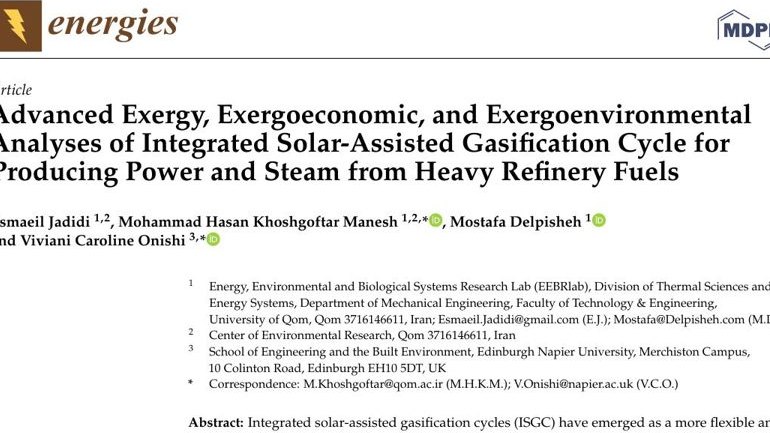
Advanced Exergy, Exergoeconomic, and Exergoenvironmental Analyses of an Integrated Solar-Assisted Gasification Cycle
Advanced exergy, exergoeconomic and exergoenvironmental analysis of an integrated solar-assisted gasification cycle producing power and steam from heavy refinery fuels. Splitting destruction into avoidable and unavoidable parts localises where thermodynamic losses can realistically be recovered.
v1.0 · Energies 14, 8409 (2021)
White paper15 min readEsmaeil Jadidi, Mohammad Hasan Khoshgoftar Manesh, Mostafa Delpisheh, Viviani Caroline Onishi
View white paper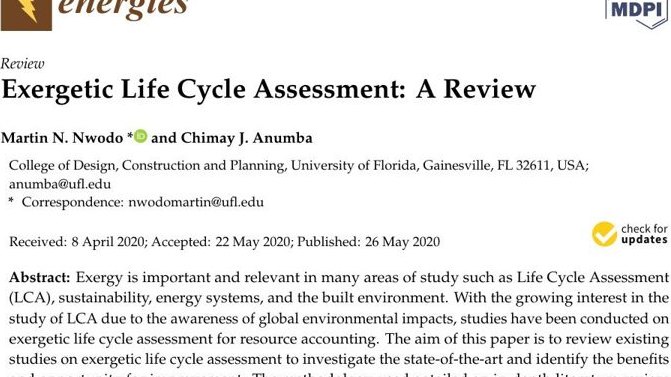
Exergetic Life Cycle Assessment: A Review
A systematic review of exergetic life cycle assessment across sustainability, energy systems and the built environment. The paper consolidates methods for resource accounting on an exergy basis, shows that exergy-based metrics provide an improved measure of sustainability, and identifies the opportunity for a more comprehensive exergetic LCA framework.
v1.0 · Energies (2020)
White paper16 min readMartin N. Nwodo, Chimay J. Anumba
View white paper
Industry
Industry briefs

Waste heat recovery and efficiency targets push thermoelectric materials towards a USD 1.59 billion market
Emergen Research values the global thermoelectric materials market at USD 728.4 million in 2025, reaching USD 1.59 billion by 2035. Waste heat recovery leads applications, while tellurium supply and modest conversion efficiency remain constraints.
Industry3 min read
Read article
IEA finds critical mineral security weakening as prices rebound and investment falls
The IEA's Global Critical Minerals Outlook 2026 reports a price rebound, refining concentration edging higher to 72%, a 9% fall in critical mineral investment and persistent copper and lithium supply deficits to 2035.
Industry3 min read
Read article
UNCTAD maps a critical minerals trade order built on export measures and partnerships
UNCTAD's Global Trade Update for June 2026 finds lithium demand rising 353% between 2024 and 2040, supply concentrated in a few countries, nearly 100 new export measures since 2020 and 73 critical mineral partnership agreements analysed.
Industry2 min read
Read article
IEA-PVPS rebuilds the benchmark PV life cycle inventory on 83 factory-level assessments
IEA-PVPS has published its first life cycle inventory update since 2020, drawing on 83 factory-level LCAs collected through France's ADEME tender process. It reports higher internally recycled silicon, lower kerf loss and markedly reduced supply chain impacts.
Industry3 min read
Read articleResearch
Research briefs

Tilting a thermal store lifts its exergy efficiency by eight points
Geometry is a free variable in thermal storage. Inclining a paraffin shell-and-tube store changes the natural convection field enough to move exergy efficiency by several points.
Research2 min read
Read article
Sensible against latent: a packed bed puts the two storage routes side by side
Most storage comparisons are made across papers, rigs and assumptions. This one holds the hardware fixed and swaps only the medium.
Research2 min read
Read article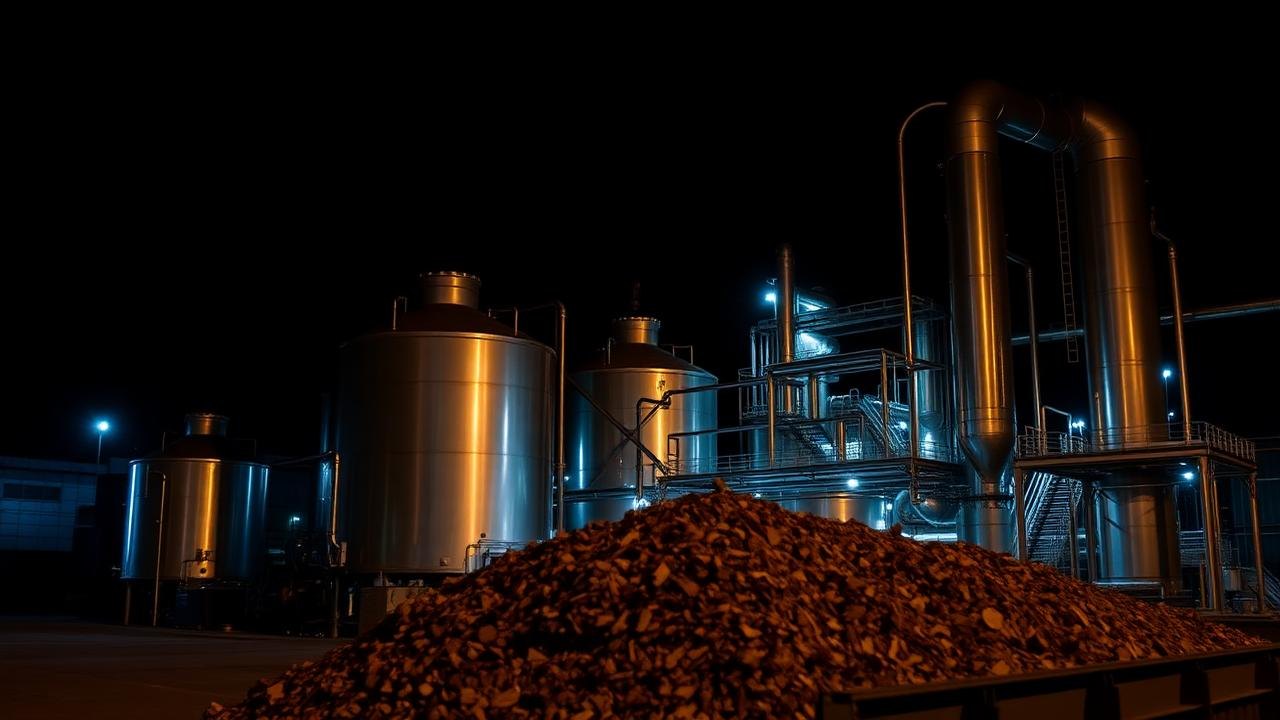
Hydrogen or ammonia from residues: an exergy and environmental comparison
Residual biomass can be turned into hydrogen or into ammonia. The two routes look similar on a mass balance and quite different on an exergy balance.
Research2 min read
Read article
Maize cobs in a concentric tube reactor: allothermal gasification assessed on exergy
Allothermal gasification supplies process heat from outside the bed. The exergy balance shows what that architecture buys, and what the external heat costs.
Research2 min read
Read articleWhite papers
White papers

The Exergy of Electrification: Heat Pumps, Hydrogen and the Rational Use of Electricity
This technical report examines electrification through the lens of exergy, defining electricity as a premium carrier produced at nearly 100 percent quality. By auditing transport, heating, and industry, it introduces an 'electricity merit order' to prioritise high-leverage uses like heat pumps and electric motors. The document critiques 'carrier-neutral' accounting and identifies that a merit-order approach to domestic heating could reduce peak infrastructure demand by five-sixths compared to resistive or hydrogen-based alternatives.
White papers17 min read
Read article
Waste Heat Is Not Waste: The Global Exergy Opportunity in Industry
This seventh volume in the Exerginity series evaluates industrial rejected heat, estimated at thousands of terawatt-hours annually, as a critical energy resource. By categorising heat into high, medium, and low temperature bands, author Wim Adriaan Bakker demonstrates how exergy-based assessments identify commercial recovery opportunities. The paper outlines a technical toolkit for using, moving, upgrading, converting, and storing heat across nine industrial sectors, concluding that temperature-graded inventories and formal offtake agreements are essential for establishing a viable recovery economy.
White papers17 min read
Read article
From Energy Transition to Exergy Transition: A Better Framework for Global Decarbonization
This white paper proposes the Exergy Transition framework to address limitations in carbon-only accounting. By applying energy, exergy, exergoeconomic, and exergoenvironmental analysis (the 4E method), the paper introduces three indicators: second-law efficiency, avoidable destruction cost, and avoidable impact. Wim Adriaan Bakker demonstrates how identifying thermodynamic irreversibilities can optimise decarbonisation routes, potentially reducing the required scale of new generation infrastructure by factors of three to five through more intelligent resource use and resource-quality management.
White papers16 min read
Read article
The Global Exergy Report: Where Humanity Destroys Useful Energy and What We Can Do About It
This report establishes an annual audit of global second-law efficiency, mapping the flow of six hundred exajoules harvested annually. Utilising engineering coefficients and historical exergy accounting, the research identifies seven primary sectors of destruction, including thermal power and low-temperature heating. It introduces the Exerginity Global Exergy Index (EGEI) to rank nations and industries, concluding that adopting ten specific technological levers, such as heat pumps and electrification, can double global energy intelligence within a generation.
White papers20 min read
Read article